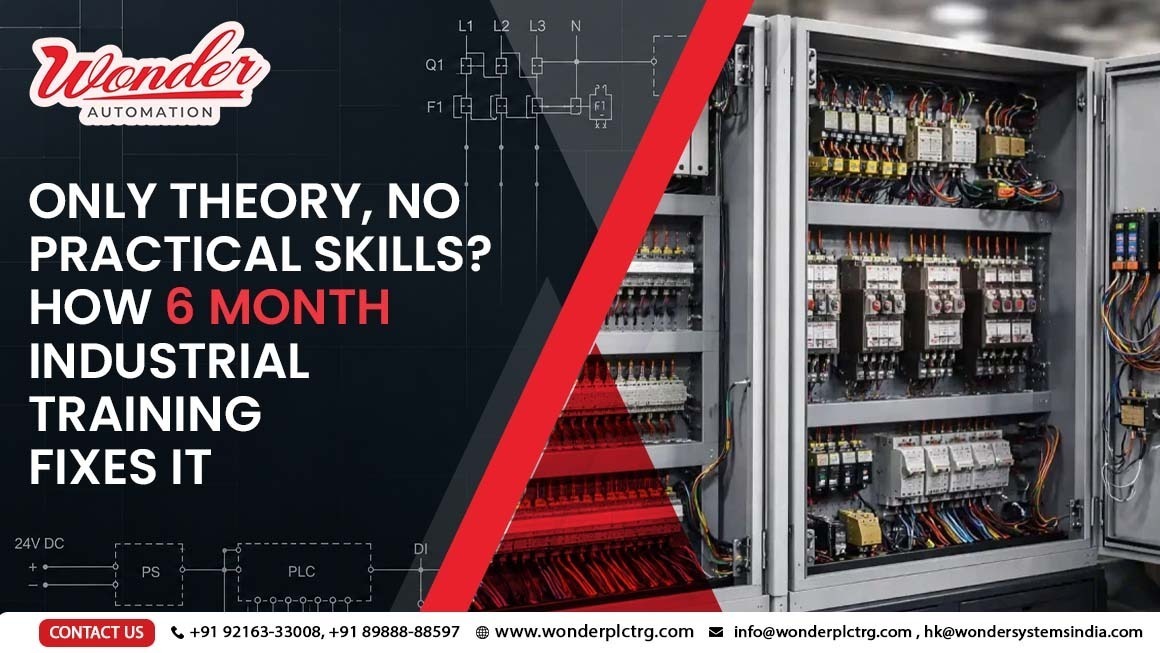
Engineering colleges teach control loop theory on whiteboards, but modern factories run on live PLCs, SCADA networks, and automated sensors. According to government data from the India Skills Report, overall graduate employability sits at 56.35%, leaving nearly 43.7% of technical graduates looking to build stronger practical troubleshooting skills.
Enrolling in a comprehensive 6 month Industrial Training program gives engineering freshers the hands-on hardware exposure required to land core engineering jobs. In this blog, we explore how 6-month practical training bridges the skill gap, builds technical confidence, and helps you launch successful automation career.
Why a 6 Month Industrial Training Program Accelerates Career Growth
Long-term practical learning gives engineering students the time needed to master complex industrial systems. A comprehensive 6 month Industrial Training allows you to go beyond software simulations, and work directly with physical control panels, field sensors, and real-world industrial hardware.
Hardware Panel Wiring & IO Testing
Multi-Brand PLC-SCADA-HMI Integration
Live Fault Simulation & Troubleshooting
During a 6 months Training, freshers gain in-depth, repetitive practice on live hardware. In core automation jobs, engineers need to wire input/output modules, establish communication protocols like PROFINET or Modbus, and program motor controls—skills that develop best through extended, hands-on hardware practice.
What You Gain in a 6 Months Industrial Training Program
Here is how a full 6-month hands-on program equips you with complete industrial skills:
| Training Feature | 6 Months Industrial Training Benefits |
| Hardware Access | Daily hands-on practice with live PLCs, VFD motor drives, HMIs, and sensors. |
| Brand Exposure | Comprehensive practice across leading brands: Siemens, Allen-Bradley, Delta, and Schneider. |
| System Integration | Complete integration of PLC, SCADA and HMI working together. |
| Troubleshooting | Live fault creation, loop testing, wire checking, and physical panel debugging. |
| Industrial Projects | End-to-end industrial project builds like bottling lines, conveyor belts, and batching systems. |
How 6-Month Practical Training Makes You Job-Ready
1. Panel Wiring & Hardware Setup
Factory programming is only half the job. Engineers must read electrical schematics, connect field sensors to PLC cards and configure VFD drives for motor speed. With extended training, you have plenty of lab time to wire a control panel from scratch, so you can prevent the common mistakes made by beginners when programming your PLC.
2. Practice Across Multiple PLC Brands
Factories use different automation brands. Long-term training builds your skills across ladder logic and function blocks on various platforms, helping you see why an industrial automation course after B.Tech is worth it.
3. Full Automation Architecture
Factories depend on connected configurations that involve a real-time logic performed by the PLCs, operator screens presented on HMI displays, and data captured by SCADA systems. In 3 months vs 6 months industrial training, it is evident that by sticking to a longer period you can smoothly incorporate all three systems and create entire control networks.
Kickstart Your Career with Wonder Automation
Building strong hardware skills is the most direct way to boost your engineering career. A practical training program at Wonder moves away from theory to real factory application. You will be working straight with industry standard PLCs, SCADA networks, HMIs and VFD panels with the guidance of experienced field engineers.
The 6 month Industrial Training program at Wonder Automation is designed to give you the hands-on experience, real-life project exposure and placement assistance you need to start your automation engineering career off on the right foot.
FAQs
Q1. Why is a 6 month Industrial Training recommended for engineering freshers?
It provides the extended time required to master live panel wiring, SCADA system integration, multi-brand PLC programming, and real-time hardware troubleshooting that top manufacturing companies look for.
Q2. Why do fresh engineering graduates benefit from hands-on industry training?
Through practical training, college theory is put into practice, and the hands-on debugging of the panel, analog signal scaling, is helpful for freshers to pass technical job interviews with confidence.
Q3. What type of hardware do students use for a 6-month automation training?
Hands-on with physical PLCs (Siemens, Allen-Bradley, Delta), VFD motor drives, HMI touch screens, SCADA software, pneumatic valves and field sensors.
Q4. How does practical training help in finding an automation job?
Practical experience allows freshers to apply for positions like Automation Engineer, PLC Programmer, Control System Specialist, and Maintenance Engineer without having to undergo extensive on-the-job training.
Q5.Which engineering streams can enroll in Industrial automation training?
Students of Electrical, Electronics, Instrumentation, Mechanical and Mechatronics can enroll to add skills in demand to control systems.


Wonder Automation is an industrial automation training institute in Mohali, Punjab and has more than 30 years experience in the industry. We focus on the training of PLC programming, SCADA, HMI and automation system.
We aim to fill this gap between the academic studies and industry demands with practical, project based courses. We have convenient schedules, professional training by qualified engineers, and placement facilities to students and working professionals.